Kamis, 21 Februari 2013

Sleeping Beauty

Sleeping Beauty


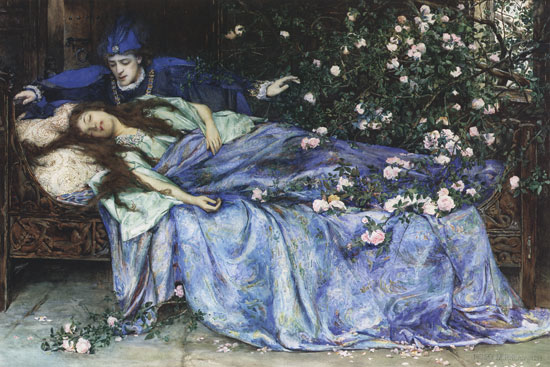
File:Henry Meynell Rheam - Sleeping Beauty.jpgOnce upon a time, there was a King and Queen. And when their baby daughter was born they were so happy they decided to have a big party. They invited all their family, all their friends and all the fairies in the land. Now there were 13 fairies altogether but the king but queen only invited 12. They forgot about the 13th. And that was something they should not have done.
Well, it was a splendid party! There were silver dishes piled high with delicious food and golden plates at every place. And when everyone had finished eating, the fairies gathered around the baby's cradle and they each made a magic wish. The princess shall be beautiful said the first. And happy, said the second. And kind, said the third. And so they went on. The princess was to be brave, and clever and truthful. She was to have a sweet singing voice and light dancing feet
And, then, just as the twelfth fairy was about to make her wish, in came the thirteenth. She was furious, because she had not been invited to the party. Here is my wish, she said. "When the princess is 16 years old, she will prick her finger on a spindle and she will die." And with that, the thirteenth fairy vanished.
hen the 12th fairy said, "I cannot change all of the wicked fairies powerful magic." So the princess will prick her finger but she will not die! She slept for a hundred years. The king and queen thanked the fairy for her kindness but they were not happy. They did not want their daughter to sleep for a hundred years. So they ordered that every spinning wheel and spindle in the land must be chopped up and burnt. Then they thought that the princess was safe.
The years passed and the princess grew up. She was very beautiful and clever at lots of different things. She was, in fact, everything the fairies had wished her to be. On her sixteenth birthday, the princess was exploring the castle when she came to a little room at the top of a tall tower. And in that room was an old woman sitting by a spinning wheel. "What are you doing?" asked the princess?"
"I am spinning," said the old woman, who was really the wicked thirteenth fairy, "would you like to try?"
"Oh yes," said the princess, and she sat down by the spinning wheel. But as soon as she touched the spindle, the sharp point pricked her finger and she fell asleep.
And the old woman vanished. At that same moment, the king and the queen, the servants, the cats and the dogs all fell asleep! Even the fire stopped burning and the roasting meat stopped sizzling. Everything slept.
Then a hedge of wild roses grew up around the castle. It grew and it grew until the castle was hidden.
One hundred years passed and then a prince came riding by and saw the top of the tower rising up above the hedge of roses. How strange, he said, I never knew there was a castle here!
He jumped off his horse and lifted his sword to cut away the hedge. But as soon as the sword touched the branch, a path opened up in front of him. So prince walked freely through the hedge. He entered castle, and walked from room to room. Imagine his surprise, everyone and everything was fast asleep.
At last he entered a little room at the end of a tall tower and he saw the sleeping princess. She was so very beautiful that he bent down and kissed her. Then the spell was broken and the princess opened her eyes.
At the same moment, everyone and everything in the castle awoke! The king yawned, the queen blinked, the cats had a good stretch and the dogs wagged their tails.
The servants began to work, the fire began to flame, and the roasting meat began to sizzle. A hundred years had not changed anyone or anything.
And what happened next? Why the beautiful princess married the prince, who had woken her from such a long deep sleep.
The End.

Snow White

Snow White


snow01.jpgAt the beginning of the story, a queen sits sewing at an open window during a winter snowfall when she pricks her finger with her needle, causing three drops of blood fall onto the snow on the ebony window frame. Admiring the beauty of the resulting color combination, she says to herself: "Oh, how I wish that I had a daughter that is as white as snow, as red as blood, and as black as that wood of the window frame". Soon after, the queen indeed gives birth to a baby girl as white as snow, as red as blood, and with hair as black as ebony. They name her Snow White, and not long after, the queen dies.
After a year has passed, the King takes a new wife, who is beautiful but also unutterably wicked and vain. The new Queen possesses a magical mirror, which she asks every morning: "Magic mirror in my hand, who is the fairest in that land?". The mirror always replies: "My Queen, you are the fairest in that land." The Queen is always pleased with that, because the magic mirror never lies. But, when Snow White reaches the age of seven, she becomes as beautiful as the day and even more beautiful than the Queen and when the Queen asks her mirror, it responds: "My Queen, you are the fairest here so true. But Snow White is a thousand time more beautiful than you."
This gives the queen a great shock, and she becomes yellow and green with envy, and from that hour her heart turns against Snow White, and with every following day she hates Snow White more and more. Envy and pride, like ill weeds, grow in her heart taller every day, until she has no peace day or night. The Queen orders a huntsman to take Snow White into the deepest woods to be killed. She demands as proof that Snow White is dead, he returns with her lungs and liver. The huntsman takes Snow White into the forest. After raising his knife, he finds himself unable to kill her as she sobs heavily and begs him: "Oh, dear huntsman, don´t kill me! Leave me with my life, I will run into the forest and never come back!". The huntsman leaves her behind alive, convinced that the girl would be eaten by some wild animal. He instead brings the Queen the lungs and liver of a young boar, which is prepared by the cook and eaten by the Queen.
After meandering through the forest for days, Snow White discovers a tiny cottage belonging to a group of seven Dwarfs. Since no one is at home, she eats some of the tiny meals, drinks some wine and then tests all the beds. Finally the last bed is comfortable enough for her and she falls asleep. When the Dwarfs return home, they immediately become aware that someone sneaked in secretly, because everything in their home is in disorder. During their loud discussion about who sneaked in, they discover the sleeping Snow White. The girl wakes up and explains to them what happened and the Dwarfs take pity on her, saying: "If you will keep house for us, and cook, make beds, wash, sew, and knit, and keep everything clean and orderly, then you can stay with us, and you shall have everything that you want." They warn her to be careful when alone at home and to let no one in when they are away delving in the mountains.
snow10.gif - 26.1 KMeanwhile, the Queen asks her mirror once again: "Magic Mirror in my hand, who is the fairest in that land?" The mirror replies: "My Queen, you are the fairest here so true. But Snow White beyond the mountains at the seven Dwarfs is thousand times more beautiful than you."[1] The Queen is horrified to learn that the huntsman has betrayed her and that Snow White is still alive. She keeps thinking about how to get rid of Snow White, then she disguises herself as an old peddler. The Queen then walks to the cottage of the Dwarfs and offers colourful, silky stay-laces and convinces the girl to take the most beautiful stay-lace as a present. Then the Queen laces it so tight that Snow White faints, causing the Queen to leave her for dead. But the Dwarfs return just in time and Snow White revives when the Dwarfs loosen the lace.
Next morning the Queen consults her mirror anew and the mirror reveals Snow White's survival. Now infuriated, the Queen dresses as a comb seller and convinces Snow White to take a beautiful one as a present. She brushes Snow White's hair with a poisoned comb and the girl faints again, but she is revived by the Dwarfs. And the next morning the mirror tells the Queen, that Snow White is still 'thousand times more beautiful' than its mistress. Now the Queen nearly has a cardiac arrest in shock and rage. As a third and last try, she secretly consults the darkest magic and makes a poisoned apple, and in the disguise of a farmer's wife, she offers it to Snow White. The girl is, at first, hesitant to accept it, so the Queen cuts the apple in half, eating the white (harmless) part and giving the red (poisoned) part to Snow White. The girl eagerly takes a bite and falls into a state of suspended animation, causing the Queen to triumph. This time, the Dwarfs are unable to revive the girl, because they can´t find the source of Snow White's poor health and, assuming that she is dead, they place her in a glass coffin.
Time passes, and a Prince traveling through the land sees Snow White. He strides to her coffin, and enchanted by her beauty, instantly falls in love with her. The Dwarfs succumb to his entreaties to let him have the coffin, and as his servants carry the coffin away, they stumble on some roots. The tremor caused by the stumbling causes the piece of poisoned apple to dislodge from Snow White's throat, awakening her. The Prince then declares his love for her, and soon a wedding is planned. The couple invites every Queen and King to come to the wedding party, including Snow White's stepmother. Meanwhile, the Queen, still believing that Snow White is dead, again asks her magical mirror who is the fairest in the land. The mirror says: "You, my Queen, are fair so true. But the young Queen is a thousand times fairer than you."
Appalled in disbelief and with her heart full of fear and doubts, the Queen is, at first, hesitant to accept the invitation, but she eventually decides to go. Not knowing that this new queen was indeed her stepdaughter, she arrives at the wedding, and her heart fills with the deepest of dread when she realizes the truth. As a punishment for her attempted murders, a pair of glowing-hot iron shoes are brought forth with tongs and placed before the Queen. She is forced to step into the burning shoes and to dance until she drops dead


Rabu, 20 Februari 2013

Cinderella

 Cinderella

Once upon a time there was a beautiful girl called Cinderella and she had two ugly step sisters who were very unkind who made her do all the hard work. She had to sweep the floors, do all the dishes, while they dressed up in fine clothes and went to lots of parties.
One day a special invitation arrived at Cinderella's house. It was from the royal palace. The king's only son was a truly handsome prince was going to have a grand ball. Three girls were invited to come. Cinderella knew she wouldn't be allowed
Once upon a time there was a beautiful girl called Cinderella and she had two ugly step sisters who were very unkind who made her do all the hard work. She had to sweep the floors, do all the dishes, while they dressed up in fine clothes and went to lots of parties.
One day a special invitation arrived at Cinderella's house. It was from the royal palace. The king's only son was a truly handsome prince was going to have a grand ball. Three girls were invited to come. Cinderella knew she wouldn't be allowed to go to the ball. But the ugly sisters, ho ho ho, they were excited. They couldn't talk about anything else.
to go to the ball. But the ugly sisters, ho ho ho, they were excited. They couldn't talk about anything else. 
When the day of the ball came, they made such a fuss. Poor Cinderella had to rush about upstairs and downstairs. She fixed their hair in fancy waves and curls. She helped them put on their expensive new dresses. And she arranged their jewels just so. As soon as they had gone, Cinderella sat down by the fire and she said. "Oh I do wish I could go to the ball". The next moment, standing beside her was a lovely old lady with a silver wand in here hand. "Cinderella, she said " I am your fairy godmother and you shall go to the ball. But first you must go into the garden and pick a golden pumpkin, then bring me six mice from the mousetraps, a whiskered rat from the rat trap, and six lizards. You'll find the lizards behind the watering can.
So Cinderella fetched a golden pumpkin, six grey mice, a whiskered rate, six lizards. The fairy godmother touched them with her wand and the pumpkin became a golden coach, the mice became six grey horses, the rat became a coachman with the most enormous moustache, and the lizards became six footmen dressed in green and yellow, then the fairy godmother touched Cinderella with the wand and her old dress became a golden dress sparkling with jewels while on her feet was the prettiest pair of glass slippers ever seen. Remember said the fairy godmother you must leave the ball before the clock strikes twelve because at midnight the magic ends. "Thank you fairy godmother" said Cinderella and she climbed into the coach.
When Cinderella arrived at the ball she looked so beautiful that everyone wondered who she was! Even the ugly sisters. The Prince of course asked here to dance with him and they danced all evening. He would not dance with anyone else. Now Cinderella was enjoying the ball so much that she forgot her fairy godmothers warning until it was almost midnight and the clock began to strike. One. Two. Three. She hurried out of the ballroom. Four. Five. Six. As she ran down the palace steps one of her glass slippers fell off. Seven. Eight. Nine. She ran on toward the golden coach. Ten Eleven Twelve. Then there was Cinderella in her old dress. The golden pumpkin lay in her feet. And scampering down off down the road were six grey mice, a whiskered rat and six green lizards.. So Cinderella had to walk home and by the time the ugly sisters returned home was sitting quietly by the fire.
Now when Cinderella ran from the palace, the prince tried to follow her and he found the glass slipper. He said, "I shall marry the beautiful girl whose foot fits this slipper and only her. IN the morning the prince went from house to house with the glass slipper and every young lady tried to squeeze her foot into it. But it didn't' fit any of them.
At last the prince came to Cinderella's house. First one ugly sister tried to squash her foot into the slipper. But her foot was too wide and fat. Then the other ugly sister tried but her foot was too long and thin. Please said Cinderella, let me try. "The slipper won't fit you", said the ugly sisters. "You didn't go to the ball!" But Cinderella slipped her foot into the glass slipper and it fit perfectly. The next moment standing beside her was the fairy godmother. She touched Cinderella with the wand and there she was in a golden dress sparkling with jewels and on her feet was the prettiest pair of glass slippers ever seen. The ugly sisters were so surprised that, for once they couldn't think of anything to say. But the Prince knew what to say. He asked Cinderella to marry him.
And then there was a happy wedding. Everyone who had gone to the ball was invited, even the ugly sisters. There was wonderful food, lots of music and dancing. And the Prince of course danced every dance with Cinderella. He would not dance with anyone else.

Selasa, 19 Februari 2013

Simple Future Tense

Simple Future


Simple Future has two different forms in English: "will" and "be going to." Although the two forms can sometimes be used interchangeably, they often express two very different meanings. These different meanings might seem too abstract at first, but with time and practice, the differences will become clear. Both "will" and "be going to" refer to a specific time in the future.

FORM Will

[will + verb]
Examples:
  • You will help him later.
  • Will you help him later?
  • You will not help him later.

FORM Be Going To

[am/is/are + going to + verb]
Examples:
  • You are going to meet Jane tonight.
  • Are you going to meet Jane tonight?
  • You are not going to meet Jane tonight.

USE 1 "Will" to Express a Voluntary Action

"Will" often suggests that a speaker will do something voluntarily. A voluntary action is one the speaker offers to do for someone else. Often, we use "will" to respond to someone else's complaint or request for help. We also use "will" when we request that someone help us or volunteer to do something for us. Similarly, we use "will not" or "won't" when we refuse to voluntarily do something.
Examples:
  • I will send you the information when I get it.
  • I will translate the email, so Mr. Smith can read it.
  • Will you help me move this heavy table?
  • Will you make dinner?
  • I will not do your homework for you.
  • I won't do all the housework myself!
  • A: I'm really hungry.
    B: I'll make some sandwiches.
  • A: I'm so tired. I'm about to fall asleep.
    B: I'll get you some coffee.
  • A: The phone is ringing.
    B: I'll get it.

USE 2 "Will" to Express a Promise

"Will" is usually used in promises.
Examples:
  • I will call you when I arrive.
  • If I am elected President of the United States, I will make sure everyone has access to inexpensive health insurance.
  • I promise I will not tell him about the surprise party.
  • Don't worry, I'll be careful.
  • I won't tell anyone your secret.

USE 3 "Be going to" to Express a Plan

"Be going to" expresses that something is a plan. It expresses the idea that a person intends to do something in the future. It does not matter whether the plan is realistic or not.
Examples:
  • He is going to spend his vacation in Hawaii.
  • She is not going to spend her vacation in Hawaii.
  • A: When are we going to meet each other tonight?
    B: We are going to meet at 6 PM.
  • I'm going to be an actor when I grow up.
  • Michelle is going to begin medical school next year.
  • They are going to drive all the way to Alaska.
  • Who are you going to invite to the party?
  • A: Who is going to make John's birthday cake?
    B: Sue is going to make John's birthday cake.

USE 4 "Will" or "Be Going to" to Express a Prediction

Both "will" and "be going to" can express the idea of a general prediction about the future. Predictions are guesses about what might happen in the future. In "prediction" sentences, the subject usually has little control over the future and therefore USES 1-3 do not apply. In the following examples, there is no difference in meaning.
Examples:
  • The year 2222 will be a very interesting year.
  • The year 2222 is going to be a very interesting year.
  • John Smith will be the next President.
  • John Smith is going to be the next President.
  • The movie "Zenith" will win several Academy Awards.
  • The movie "Zenith" is going to win several Academy Awards.

IMPORTANT

In the Simple Future, it is not always clear which USE the speaker has in mind. Often, there is more than one way to interpret a sentence's meaning.

No Future in Time Clauses

Like all future forms, the Simple Future cannot be used in clauses beginning with time expressions such as: when, while, before, after, by the time, as soon as, if, unless, etc. Instead of Simple Future, Simple Present is used.
Examples:
  • When you will arrive tonight, we will go out for dinner. Not Correct
  • When you arrive tonight, we will go out for dinner. Correct

ADVERB PLACEMENT

The examples below show the placement for grammar adverbs such as: always, only, never, ever, still, just, etc.
Examples:
  • You will never help him.
  • Will you ever help him?
  • You are never going to meet Jane.
  • Are you ever going to meet Jane?

ACTIVE / PASSIVE

Examples:
  • John will finish the work by 5:00 PM. Active
  • The work will be finished by 5:00 PM. Passive
  • Sally is going to make a beautiful dinner tonight. Active
  • A beautiful dinner is going to be made by Sally tonight. Passive

Simple Past Tense

Simple Past


FORM

Subjet+VERB+ed or irregular verbs
Examples:
  • You called Debbie.
  • Did you call Debbie?
  • You did not call Debbie.
USE 1 Completed Action in the Past 


Use the Simple Past to express the idea that an action started and finished at a specific time in the past. Sometimes, the speaker may not actually mention the specific time, but they do have one specific time in mind.
Examples:
  • I saw a movie yesterday.
  • I didn't see a play yesterday.
  • Last year, I traveled to Japan.
  • Last year, I didn't travel to Korea.
  • Did you have dinner last night?
  • She washed her car.
  • He didn't wash his car.

USE 2 A Series of Completed Actions


We use the Simple Past to list a series of completed actions in the past. These actions happen 1st, 2nd, 3rd, 4th, and so on.
Examples:
  • I finished work, walked to the beach, and found a nice place to swim.
  • He arrived from the airport at 8:00, checked into the hotel at 9:00, and met the others at 10:00.
  • Did you add flour, pour in the milk, and then add the eggs?
USE 3 Duration in Past

The Simple Past can be used with a duration which starts and stops in the past. A duration is a longer action often indicated by expressions such as: for two years, for five minutes, all day, all year, etc.
Examples:
  • I lived in Brazil for two years.
  • Shauna studied Japanese for five years.
  • They sat at the beach all day.
  • They did not stay at the party the entire time.
  • We talked on the phone for thirty minutes.
  • A: How long did you wait for them?
    B: We waited for one hour.
USE 4 Habits in the Past


The Simple Past can also be used to describe a habit which stopped in the past. It can have the same meaning as "used to." To make it clear that we are talking about a habit, we often add expressions such as: always, often, usually, never, when I was a child, when I was younger, etc.
Examples:
  • I studied French when I was a child.
  • He played the violin.
  • He didn't play the piano.
  • Did you play a musical instrument when you were a kid?
  • She worked at the movie theater after school.
  • They never went to school, they always skipped class.
USE 5 Past Facts or Generalizations

The Simple Past can also be used to describe past facts or generalizations which are no longer true. As in USE 4 above, this use of the Simple Past is quite similar to the expression "used to."
Examples:
  • She was shy as a child, but now she is very outgoing.
  • He didn't like tomatoes before.
  • Did you live in Texas when you were a kid?
  • People paid much more to make cell phone calls in the past.

IMPORTANT When-Clauses Happen First

Clauses are groups of words which have meaning but are often not complete sentences. Some clauses begin with the word "when" such as "when I dropped my pen..." or "when class began..." These clauses are called when-clauses, and they are very important. The examples below contain when-clauses.
Examples:
  • When I paid her one dollar, she answered my question.
  • She answered my question when I paid her one dollar.
When-clauses are important because they always happen first when both clauses are in the Simple Past. Both of the examples above mean the same thing: first, I paid her one dollar, and then, she answered my question. It is not important whether "when I paid her one dollar" is at the beginning of the sentence or at the end of the sentence. However, the example below has a different meaning. First, she answered my question, and then, I paid her one dollar.
Example:
  • I paid her one dollar when she answered my question.

ADVERB PLACEMENT

The examples below show the placement for grammar adverbs such as: always, only, never, ever, still, just, etc.
Examples:
  • You just called Debbie.
  • Did you just call Debbie?

ACTIVE / PASSIVE

Examples:
  • Tom repaired the car. Active
  • The car was repaired by Tom. Passive

Senin, 18 Februari 2013

Simple Present Tense

Simple Present

FORM

Subject+Verb+ s/es in third person

Examples:
  • You speak English.
  • Do you speak English?
  • You do not speak English.
There Are Some Functions of Simple Present

Function 1 as Repeated Actions


Use the Simple Present to express the idea that an action is repeated or usual. The action can be a habit, a hobby, a daily event, a scheduled event or something that often happens. It can also be something a person often forgets or usually does not do.
Examples:
  • I play tennis.
  • She does not play tennis.
  • Does he play tennis?
  • The train leaves every morning at 8 AM.
  • The train does not leave at 9 AM.
  • When does the train usually leave?
  • She always forgets her purse.
  • He never forgets his wallet.
  • Every twelve months, the Earth circles the Sun.
  • Does the Sun circle the Earth?

Function 2 Facts or Generalizations


The Simple Present can also indicate the speaker believes that a fact was true before, is true now, and will be true in the future. It is not important if the speaker is correct about the fact. It is also used to make generalizations about people or things.
Examples:
  • Cats like milk.
  • Birds do not like milk.
  • Do pigs like milk?
  • California is in America.
  • California is not in the United Kingdom.
  • Windows are made of glass.
  • Windows are not made of wood.
  • New York is a small city. It is not important that this fact is untrue.

Function 3 Scheduled Events in the Near Future


Speakers occasionally use Simple Present to talk about scheduled events in the near future. This is most commonly done when talking about public transportation, but it can be used with other scheduled events as well.
Examples:
  • The train leaves tonight at 6 PM.
  • The bus does not arrive at 11 AM, it arrives at 11 PM.
  • When do we board the plane?
  • The party starts at 8 o'clock.
  • When does class begin tomorrow?

Function 4 Now (Non-Continuous Verbs)


Speakers sometimes use the Simple Present to express the idea that an action is happening or is not happening now. This can only be done with Non-Continuous Verbs and certain Mixed Verbs.
Examples:
  • I am here now.
  • She is not here now.
  • He needs help right now.
  • He does not need help now.
  • He has his passport in his hand.
  • Do you have your passport with you?

ADVERB PLACEMENT

The examples below show the placement for grammar adverbs such as: always, only, never, ever, still, just, etc.
Examples:
  • You only speak English.
  • Do you only speak English?

ACTIVE / PASSIVE

Examples:

  • Once a week, Tom cleans the car. Active
  • Once a week, the car is cleaned by Tom. Passive